Safety
Safety while travelling: how do you keep your money and documents secure?
A stolen card is an annoyance; stolen cash and a stolen passport can wreck a trip. Where to carry what, which countries expect you to carry ID, and exactly what to do if something goes missing.
The short version
Spread the risk: never carry your passport, cards and cash in one place. Pay mostly by card, because under EU rules a stolen card used before you report it costs you at most €50, and nothing after you report it, while stolen cash is simply gone. Carry a second card from a different account and keep it apart from the first. Check the ID rules: Czechia, Italy and the Netherlands expect you to carry ID, while Germany does not require it. Keep a copy of your passport's photo page on your phone. If your passport is stolen, a police report will not get you home: you need an emergency travel document, which costs £125 for UK citizens as of October 2026.
On this page
Who is this guide for?
Travellers in Europe who want to limit the damage if a bag or wallet goes missing. The rules quoted come from EU law and the UK Foreign Office's travel advice, checked on 22 October 2026. For the tricks thieves use, see our guide to avoiding tourist scams in Europe.
What do you lose if cash or a card is stolen?
The way you carry money decides how much you get back. The EU Payment Services Directive limits what you pay for unauthorised payments with a lost or stolen card to €50, and to nothing once you have reported the loss to your bank. Your bank must refund an unauthorised payment by the end of the next business day. The exception is fraud or gross negligence, such as writing your PIN on the card: then there is no cap.
That is why the best protection is boring: pay by card, carry only a day's cash, and report a missing card at once.
What should I do before I leave?
- Take two cards from different accounts and keep them in different places. If one is stolen or blocked, you can still pay.
- Turn on card controls in your banking app: freezing the card, payment notifications and, if offered, limits on cash withdrawals.
- Save your bank's emergency number somewhere you can reach without your phone, in case the phone goes too.
- Copy your passport's photo page. UK advice for Spain says to keep a copy somewhere safe. Store it on your phone and in an email or cloud folder.
- Check your travel insurance for cash limits and what it needs from you after a theft; insurers usually ask for a police report.
- Book transfers ahead if you land late with luggage. See the fastest ways into town from Europe's airports.
Do I have to carry my passport?
In some countries, yes. This is what UK travel advice says for six popular destinations.
| Country | Must you carry ID? | What counts | If you cannot show it |
|---|---|---|---|
| Czechia | Yes, a legal requirement | Passport; police normally accept a scan if you have not committed a crime | Police may fine or arrest you |
| Netherlands | Yes, from age 14 | Passport for British nationals | €100 fine from age 16; €50 at 14 and 15 |
| Italy | Yes, photo ID at all times | Photo ID; police stopping a driver will normally ask for the full passport | Not stated |
| Spain | You must show photo ID if police ask | Photo ID; some shops accept a driving licence or passport copy | Not stated |
| France | You must prove your identity when asked | Passport, photocard driving licence or other government document, on the spot or within 4 hours at a police station | Not stated |
| Germany | No legal requirement | Passport | Police can take you to get your passport |
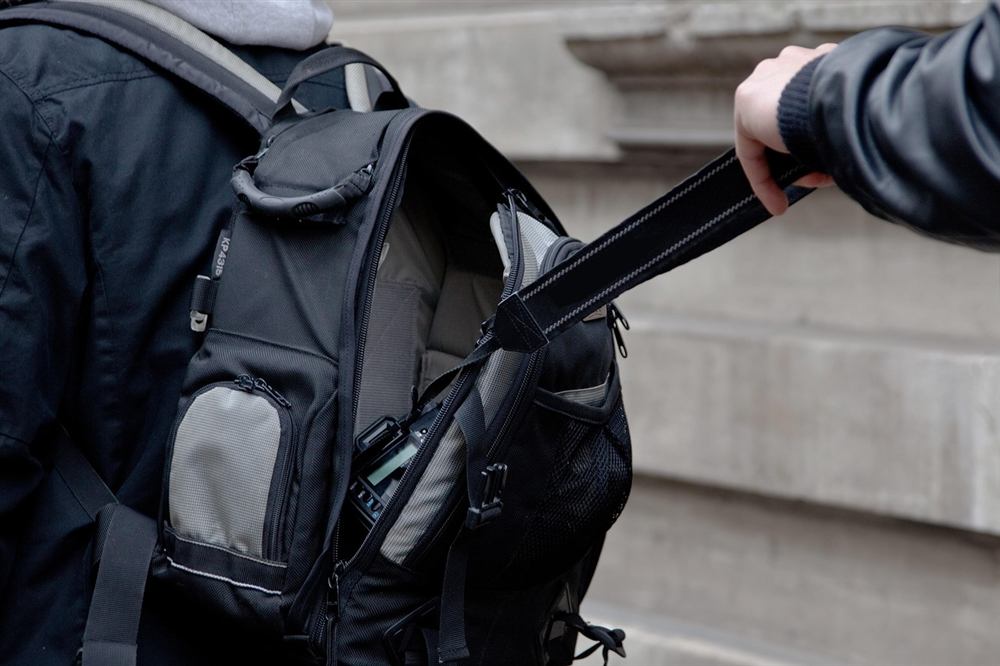
Where you must carry it, the passport goes in a zipped inside pocket or a pouch under your clothes, never in a back pocket or the outer pocket of a backpack. Where you need not, leave it in the room safe and carry a copy.
Where is the safest place to keep money and documents?
| Option | Theft risk | Meets ID rules | Access | Pros | Cons |
|---|---|---|---|---|---|
| Pouch or money belt under clothes | Low | Yes | Slow | Hard to pick; good for passport and spare card | Awkward to reach; not for daily spending |
| Zipped inside pocket or cross-body bag worn in front | Low to medium | Yes | Quick | Good for the card and cash you use today | Still a target in crowds and on transport |
| Backpack or back pocket | High | Yes, until stolen | Quick for thieves too | Convenient | Easiest to pick, especially in queues and on trains |
| Hotel room safe | Low | No, if the law says carry it | Only at the hotel | UK advice for Italy suggests it for spare cash and valuables | Easy to forget at check-out |
| Phone copy of passport and card numbers | Not applicable | Partly: accepted by Czech police in some cases | Instant | Speeds up reporting and replacement | Not a travel document; lost with the phone unless also stored online |
Who should pick what: carry the day's card and a little cash in a front or inside pocket. Keep the passport under your clothes where the law expects you to carry it, and in the room safe where it does not. Put the second card and spare cash in the safe or a separate pouch. UK advice for France and the Netherlands singles out stations and public transport for pickpockets, so that is when your bag goes in front of you.
What do I do if my cards or passport are stolen?
- Freeze or cancel your cards in your banking app or by phone. Payments after you report them are not your loss.
- Call 112 in an emergency. It works across the EU.
- Report the theft to the police and get a written report for your bank and insurer. In Czechia, UK advice says to report thefts in person at the nearest police station within 24 hours.
- Replace the passport. A police report will not let you leave: UK advice for Spain and Italy says so directly. Contact your embassy or consulate for an emergency travel document.
- Dispute any payment you did not make with your bank as soon as you can.
UK citizens apply for an emergency travel document online on GOV.UK if their passport was issued on or after 1 January 2006. As of October 2026 it costs £125, is not refundable, usually takes about 2 working days, and allows travel through up to 5 countries. Do not book travel until you are told how and when to collect it.
EU citizens go to their own country's embassy or consulate. Outside the EU, if your country has no embassy there, any other EU country's embassy can issue an EU emergency travel document, which has had a single format across the EU since 9 December 2025.
Landing late with luggage? Book your airport transfer before you fly, and skip juggling cash and bags at arrivals.
Frequently asked questions
Should I carry my passport or leave it in the hotel safe?
It depends on the country. Czechia, Italy and the Netherlands expect you to carry ID, and in Spain you must show photo ID if police ask. In Germany carrying ID is not a legal requirement. Where you must carry it, keep it in a zipped inside pocket, apart from your cards and cash.
Is a photocopy of my passport enough?
Not as a travel document, and not everywhere as ID. UK travel advice for Czechia says police will normally accept a scan of your passport if you have not committed a crime, and some shops in Spain accept a copy. Keep a copy of the photo page anyway: it speeds up a replacement if the original is stolen.
How much do I lose if my bank card is stolen and used?
Under the EU Payment Services Directive, at most €50 for payments made before you report the card, and nothing for payments after you report it, unless you acted fraudulently or with gross negligence. Your bank must refund an unauthorised payment by the end of the next business day. Stolen cash is not protected at all.
Can I fly home with a police report if my passport is stolen?
No. UK travel advice for Spain and Italy says a police report cannot be used to leave the country. You need a new passport or an emergency travel document from your embassy or consulate.
How much does a UK emergency travel document cost?
£125, as of October 2026, with no refund. It usually takes about 2 working days and is applied for online on GOV.UK if your passport was issued on or after 1 January 2006.
Where the figures come from
Checked on 22 October 2026. Travel advice and fees change; check your government's current advice before you travel.
- Directive (EU) 2015/2366 on payment services (PSD2), Articles 73 and 74
- GOV.UK: Czech Republic travel advice, safety and security
- GOV.UK: Netherlands travel advice, safety and security
- GOV.UK: Italy travel advice, safety and security
- GOV.UK: Spain travel advice, safety and security
- GOV.UK: France travel advice, safety and security
- GOV.UK: Germany travel advice, safety and security
- GOV.UK: apply for an emergency travel document
- GOV.UK: emergency travel document eligibility
- Council Directive (EU) 2019/997 establishing an EU emergency travel document
- Italian Embassy in Abidjan: EU emergency travel document, new format from 9 December 2025
Related guides
 Border checks
EES explained: what happens at Europe's border in 2027
 Schengen rules
The Schengen 90/180 rule explained, with examples